

Rights, rates and the settlement that follows.
The contract with everything that belongs to it
Master data, term, financial conditions, scope of rights, participants with their shares, title assignment, documents and dates – as tabs on a single record.
Royalty scales that do the arithmetic
Sales-based royalties with multi-step scales, as a percentage or per copy, plus advances with due dates, flat fees and contract-for-work installments – assigned per title, with title-specific shares where needed.
One statement per author, not per contract
The combined statement gathers all of a recipient's contracts that can be offset against one another onto a single document with a shared author account.
Settlement runs instead of one-by-one work
One run per period finds every contract that is due, works through them in a queue and finally provides all the documents as a ZIP.
One contract, and the figures follow.
A contract records who holds which rights in which work, and what is paid for them. The module manages acquisition and sales contracts with their term, financial conditions and scope of rights, links them to the partners from the CRM and to work and title data, and settles the royalties on that basis.
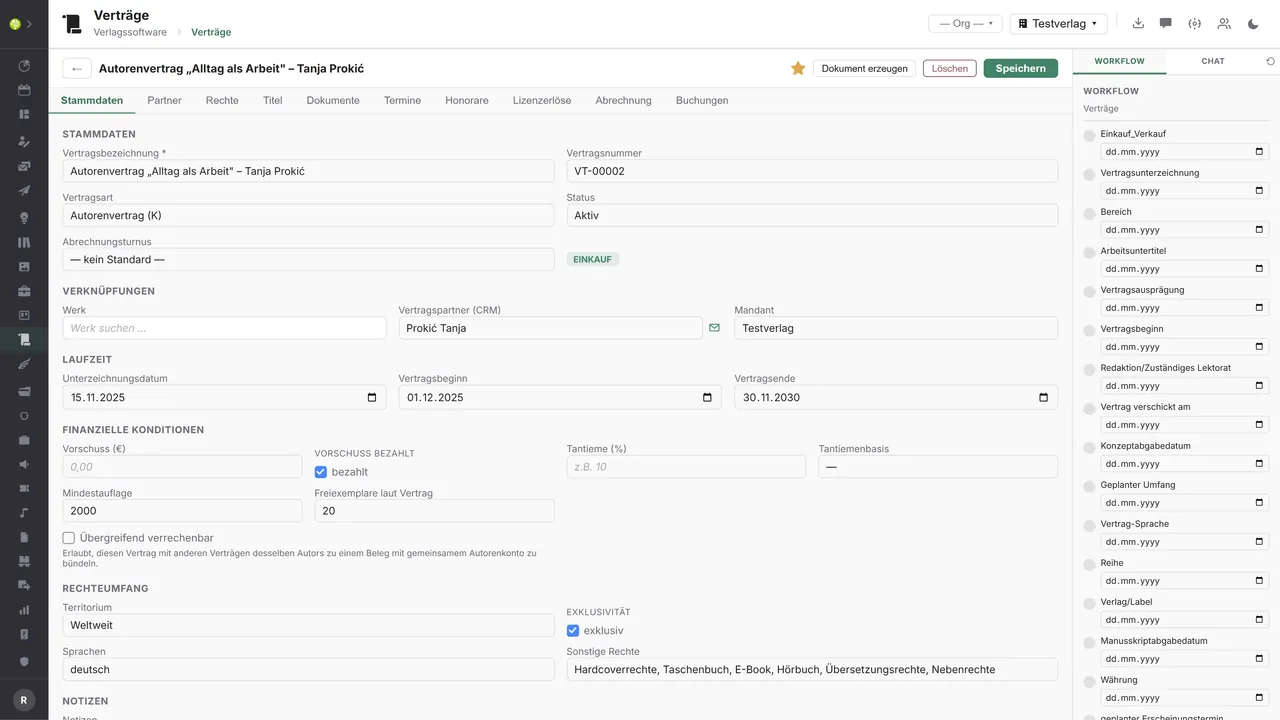
The contract list shows the total, the active contracts and those about to expire, coloring whatever ends within 90 or 30 days. The contract itself is divided into tabs: master data, partners, rights, titles, documents, dates, royalties, licensing income, settlement and postings. The workflow runs alongside on the right, asking for the stages from signature through to delivery of the manuscript.
Participants are added with their role and royalty share (author, co-author, editor, translator, illustrator, agency), together with the voucher copies per edition, which reappear as a contractually agreed quantity in complimentary copies. The rights list primary and subsidiary rights with territory, languages, exclusivity and whether they can be offset; a template per contract type pre-fills them. The title assignment states from when and until when settlement applies and at which starting sales figure, and allows title-specific shares that override the contract-wide share.
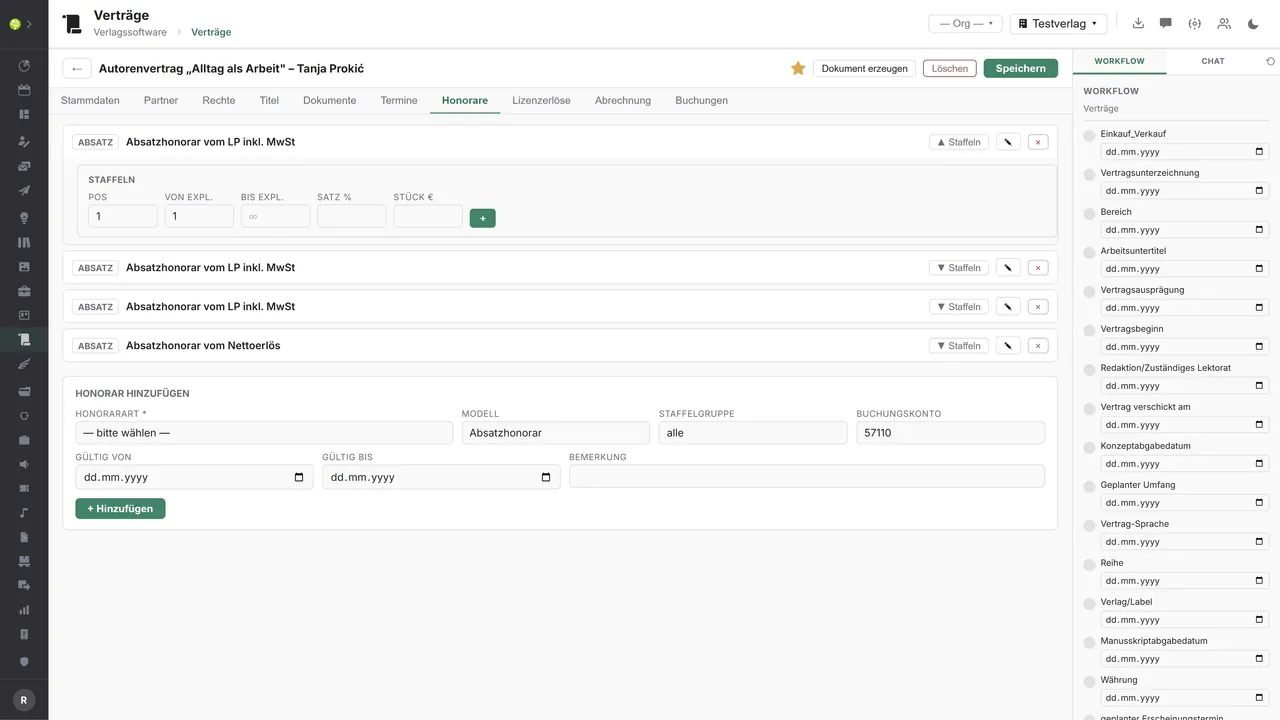
The royalty lines carry the model: sales-based royalties with scales running from copy to copy, as a percentage or per copy; advance payments with a due date and a traffic light showing whether the advance is paid, part-paid or overdue; flat fees and contract-for-work installments with their trigger. Every line brings its own posting account with it.
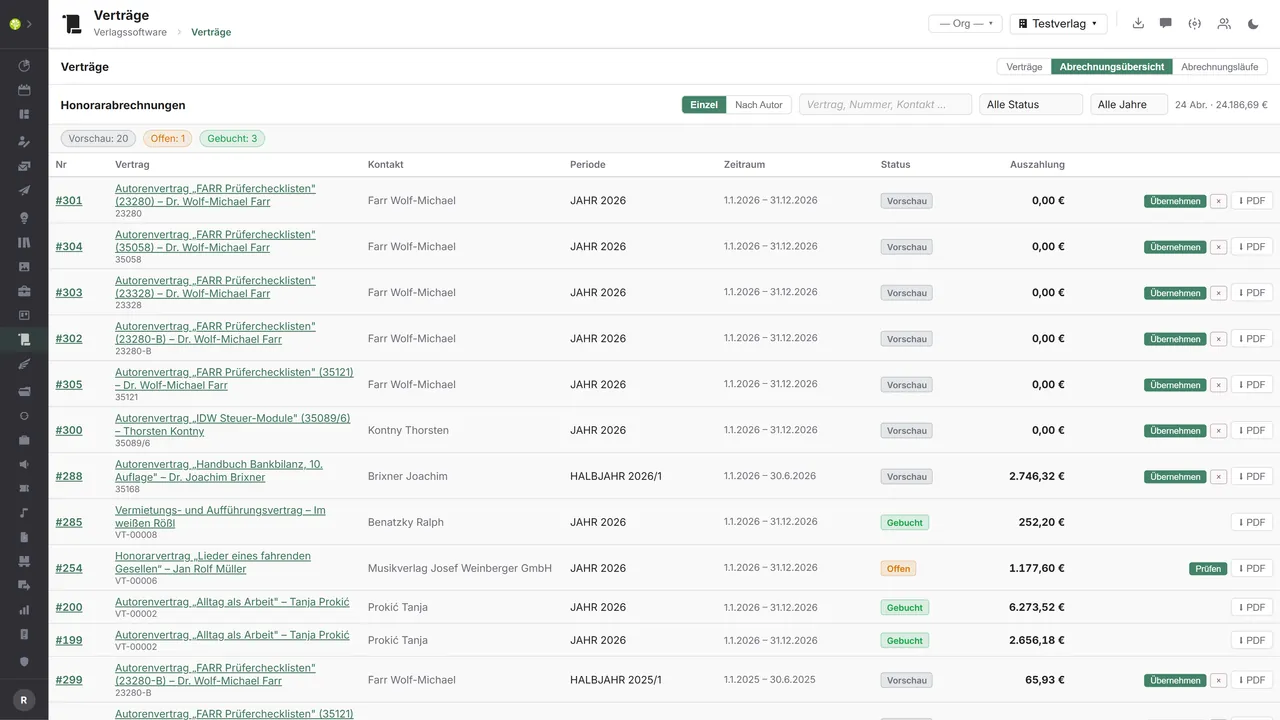
Settlement happens per period: generate a preview, accept it, check it, post it. The document number is created at the checking stage, the document itself as HTML and PDF. The author account shows the opening balance, the gross entitlement and the closing balance; a reversal creates the counter-posting, either as a reclaim or as an offset in the next period. And anyone who does not want to go contract by contract starts a settlement run.
Around the contracts lie the exploitation processes: licensing income from collecting society distributions and from other publishers, also as a bulk import that assigns the lines to contracts and works by itself; registrations with collecting societies including their responses; work registration as CWR or IWA-XML; and the counting marks and reports to VG Wort. The income is reflected in reporting; advances paid and their drafts sit with incoming invoices.
Reprint requests follow a route of their own. When a third party wants to reprint a text, it becomes a case with a status flow. A per-character rate prices the request, the invoice is created through Orders & invoices, and the income flows into the same distribution to the contracting parties as any other licensing income. There is no second settlement system beside it. A voucher copy can be requested directly from the inquiry, and the analysis per contract separates income already posted from income approved but still outstanding.
And the papers themselves come from document templates. For each contract type it is recorded which template applies – either set in the form editor or uploaded as a file edited in Word, which the system fills with the contract data and converts to PDF. Before creation, a preview shows what the document will look like and warns which placeholders would remain empty. The documents produced are then attached to the contract, with template, version, language, creator and timestamp. Which field names to use in Word is set out in a searchable reference that can also be printed.
Contracts in the application.

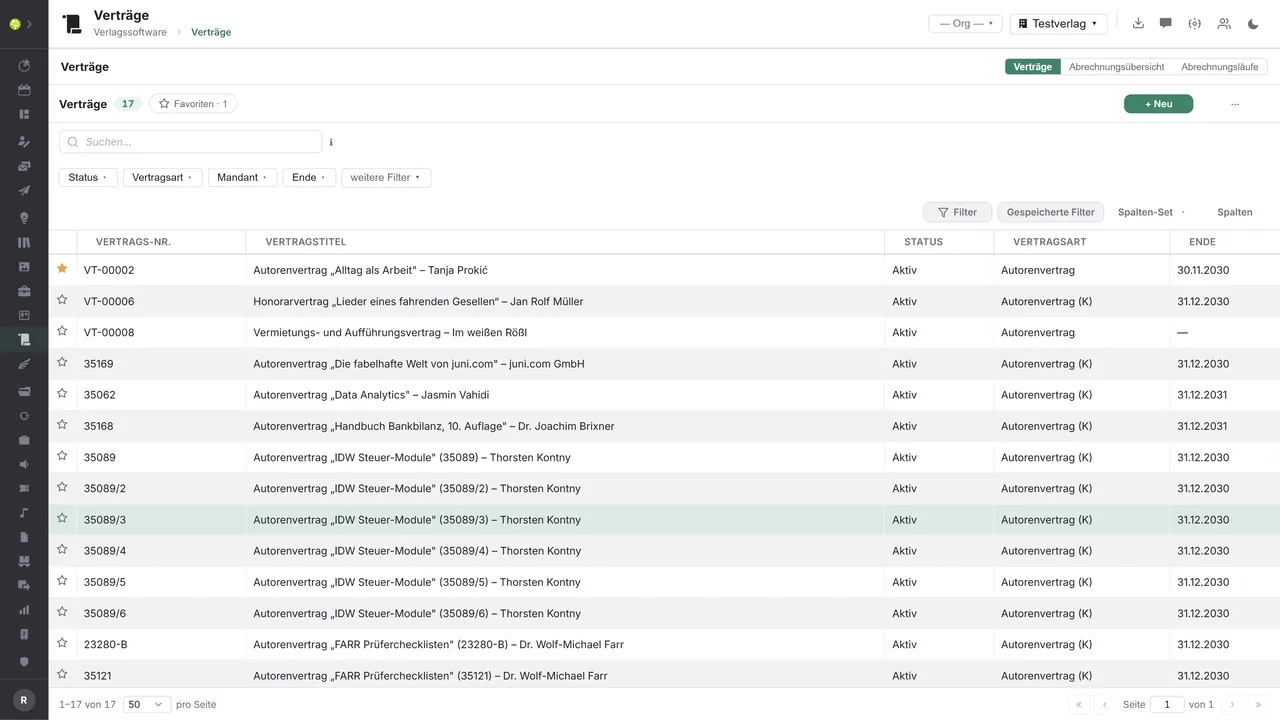

Every contract with its term in viewContract number, title, status, contract type and end date – filterable by status, contract type, tenant and expiry, with favorites and export. Top right the three views: contracts, settlement overview, settlement runs.
The contract and its tabsContract number and settlement cycle, links to work, partner and tenant, term, advance and royalty, scope of rights with territory and languages – and the contract's workflow on the right.
Royalty lines with scalesThe model on each line – here sales-based royalties on the retail price and on net receipts – with scales running from copy to copy, percentage or per copy, scale group and posting account.
Every statement in a periodIndividually or by author, with the statuses preview, open and posted, the payout amount per document and the steps accept, check and PDF – with the total across all statements at the top.
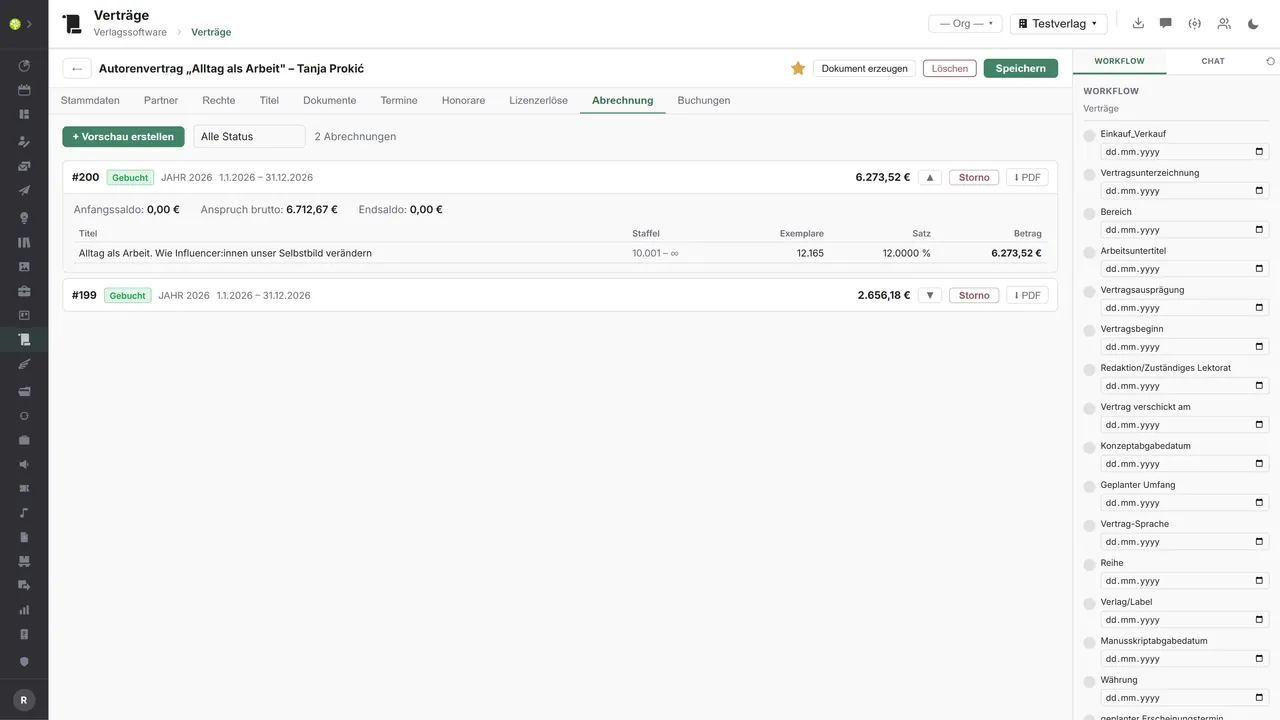
Author account and line itemsFor each statement the opening balance, gross entitlement and closing balance, and below them the line items: title, scale band, copies, rate and amount – plus reversal and PDF.

See open.junixx at work. We show you on screen how the software fits your publishing workflows – with no obligation, and with time for your questions.
Book a demoImport and export through the API.
A contract has two outward faces: as a rights matter it looks toward the collecting societies and the signature, as a money matter toward accounting, reporting duties and payout.

Import – from external services
Data flowing into the module from outside:
- Counting mark status and completed participants from VG Wort → carry the registrations forward
- Distribution amounts per work and author from VG Wort, GEMA and VG Bild-Kunst → into the settlement as licensing income
- Signature status and the signed PDF from the e-signature service → set the contract to signed
- Sales quantities and revenue per title from wholesalers, shops and reporting services → the basis for percentage royalties

Export – to external services
Data the module passes outward:
- Ordering counting marks and reporting titles to VG Wort
- Work registration with GEMA and other collecting societies
- The contract PDF with its signatories to the e-signature service
- Royalty and advance postings to accounting, payout by SEPA to the bank
The connection to VG Wort is real today: order counting marks, reconcile their status, send reports – with every external call logged. Work registrations go out as CWR and IWA-XML; responses from GEMA and settlement files from other publishers come in as a bulk import (CSV, XLSX); documents are produced as HTML and PDF, and a whole run as a ZIP. E-signature, the handover of royalty postings to accounting and payout by SEPA can be added through the central API.
More on the interfaces
Detailed overview from the interface analysis: sources for import and possible targets for export.
Import – from external services

| Source (external) | What is imported | Use in the module |
|---|---|---|
| VG Wort (METIS) | Counting mark status, completed participants, distribution | Status reconciliation into the registrations |
| VG Wort, GEMA, VG Bild-Kunst | Distribution amounts per work and author | Into the royalty settlement as licensing income |
| E-signature (DocuSign, FP Sign, Skribble) | Signature status, signed PDF, timestamp | Set the contract to signed, file the document |
| Bank (HBCI/FinTS, camt.053) | Executed payouts and returns | Mark the statement as paid out |
| Sales data (wholesalers, shops, reporting services) | Sales quantities and revenue per title | The basis for calculating percentage royalties |
| The author's tax details | Tax ID, VAT status, exemption | Correct settlement, deduction under Section 50a of the German Income Tax Act |
Export – to external services

| Purpose / trigger | External service (examples) | What is exported | Format / standard |
|---|---|---|---|
| Distribution report | VG Wort (METIS), GEMA, VG Bild-Kunst | Reporting titles and participants, counting marks | METIS interface, partner API |
| Work registration | GEMA and other collecting societies | Work, participants, shares | CWR, IWA-XML |
| Getting the contract signed | DocuSign, FP Sign, Skribble, Adobe Sign | Contract PDF and signatories | REST API, eIDAS |
| Posting royalties and advances | DATEV, Lexware, sevDesk | Postings with account, amount, document and author | DATEV EXTF (CSV) |
| Payout | Your bank via HBCI/FinTS | Payout to the author with a payment reference | SEPA pain.001 |
| Artists' social security levy | Künstlersozialkasse (German artists' social security fund) | Total royalties paid per year | Annual report |
Every feature of Contracts & royalties.
You will find the complete list in our brochure
What you see above is an excerpt. Every feature of this module – and of all the others – is collected in the open.junixx brochure. We will gladly send it to you, in print or as a PDF. And if you would rather watch than read: we are happy to show you open.junixx live on screen.
Get the brochureParticularly strong for these kinds of publishers.
Anywhere authors, editors, translators and composers share in the success – and wherever collecting societies are involved.



Connected to the publishing ecosystem
- VLB
- IDNV
- doctronic
- Amazon
- Bookwire
- Arvato / VVA
- Brocom
- Prolit
- Zeitfracht
- Magento
- WordPress /
WooCommerce - Shopify
- Shopware
- Wirth & Horn
- Diamant
- DATEV
- BMD
- Abacus
- DHL
- DPD
Get to know open.junixx.
Arrange an appointment with no obligation. We will show you how Contracts & royalties fits into your publishing routine.