
Publishing software that moves your publisher forward.
open.junixx brings your entire publishing operation together in one modern, browser-based application – developed in partnership with publishers.

Every module included
More than 25 modules and 400+ features – with nothing licensed separately.
Publishing standards
ONIX 3.0, VLB reporting and online shop integration as standard.
GDPR & security
A dedicated GDPR module, permission management and encrypted transmission.
Digital asset management
Covers, images and documents managed centrally and linked where they belong.
Every module included
What you see here is not a selection made for this website – it is the sidebar of an ordinary open.junixx installation.
On the left, the modules follow the order in which a publishing house actually works: Communication with CRM, correspondence and Media Cockpit, Publishing with works, title data, media, production, contracts and complimentary copies, Business processes with orders, subscriptions, agency, advertising, events, rental and incoming invoices.
They all draw on the same master data. A contact from the CRM appears in the order, in the contract and in the mail merge – entered once, not three times. That is why the number of modules is not a price but a description: this is one application, not a collection.
What a member of staff sees is governed by roles and permissions – not by the scope of a license. The feature set is not broken into components to be purchased one by one.
Publishing standards as standard
Here ONIX is not an export format at the end of the chain. It is right there in the field.
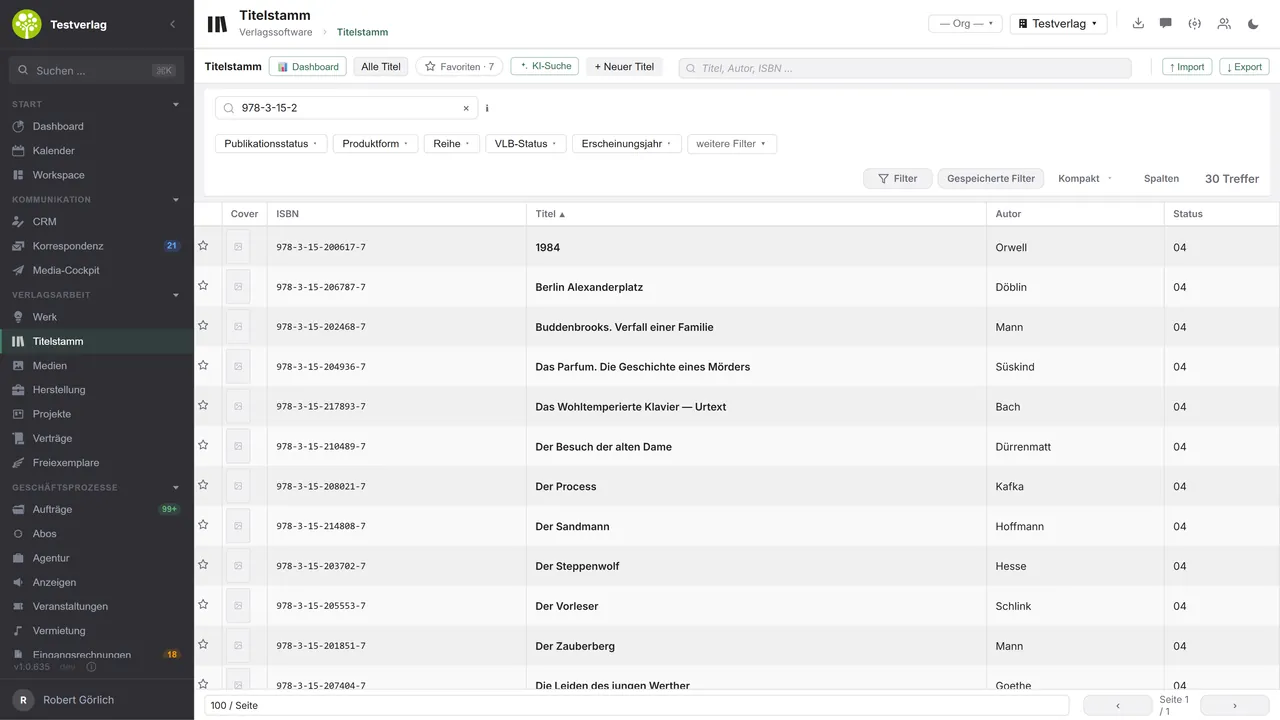
The detail view of a title shows the matching ONIX 3.0 field code next to every entry. Anyone submitting data sees straight away which field carries which code – and never has to look the mapping up in a table.
The VLB submission goes out from that same record, as does classification to Thema and BISAC. There is no second round of data entry for the sake of the standard.
The shops draw on this data too: Magento, Shopify, Shopware and WordPress/WooCommerce pull titles, prices and stock from the title data instead of being maintained separately.
Data protection as a module, not a folder
The catalog of technical and organizational measures lives in the system – with a traffic light for each measure.
open.junixx has a GDPR module of its own. It keeps the records of processing activities, the technical and organizational measures by control type, data breaches and risks. An assessment turns all of it into a current status with a gap report – showing what is still open before anyone from outside asks.
The complete file can be exported, for the supervisory authority or for your own audit. And it is built from the data you already maintain, not from a text document kept alongside it.
Who gets to see which data is governed by permission management through roles and levels; transmission is encrypted throughout.
One repository instead of ten folders
Covers, images and documents do not sit on a shared drive – they sit with the title.
The media overview shows thumbnails, filters and a search bar that also finds things by meaning – not just by file name. Search for “cover with a string instrument” and you do not need to know what the file is called.
Every asset is attached to its title or work. Open the title and the cover is right there; replace the cover and it is replaced everywhere.
Rights and licenses are held on the asset itself, with an expiry date. Changes are kept as versions and can be restored. AI tagging and alt texts come on top if you want them.
This is what open.junixx looks like.
Real views from the application – choose an area.
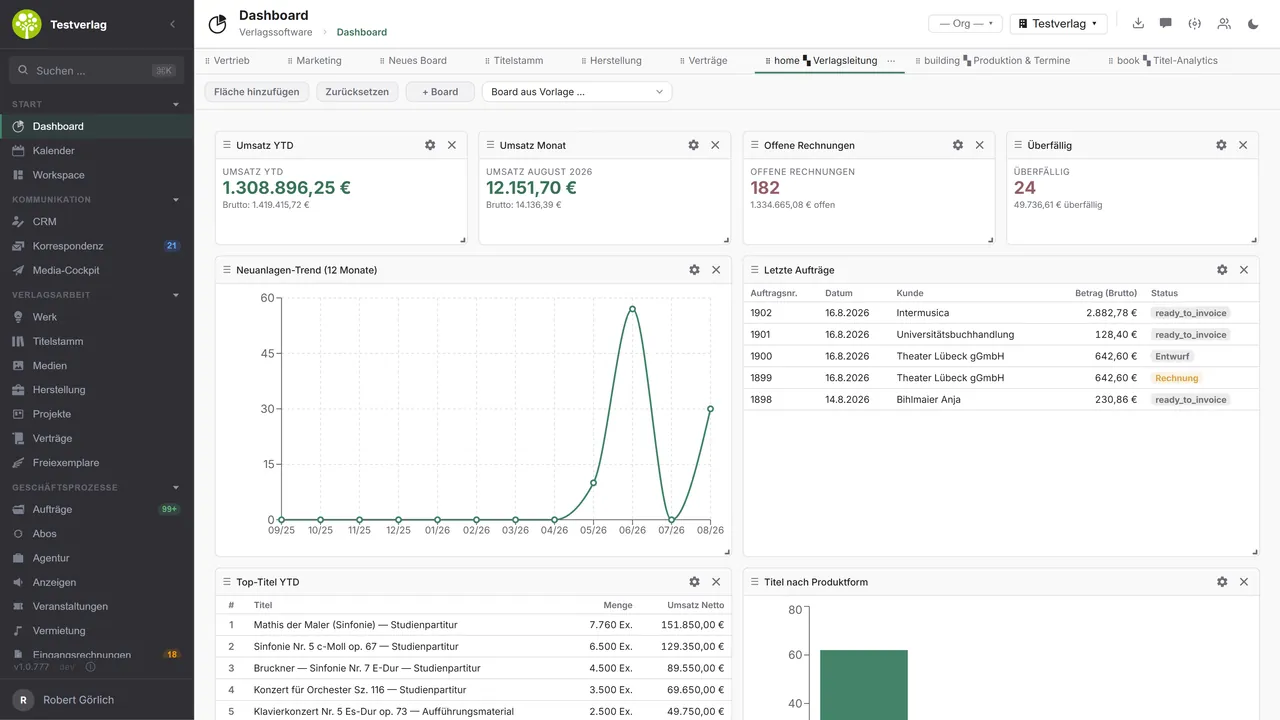
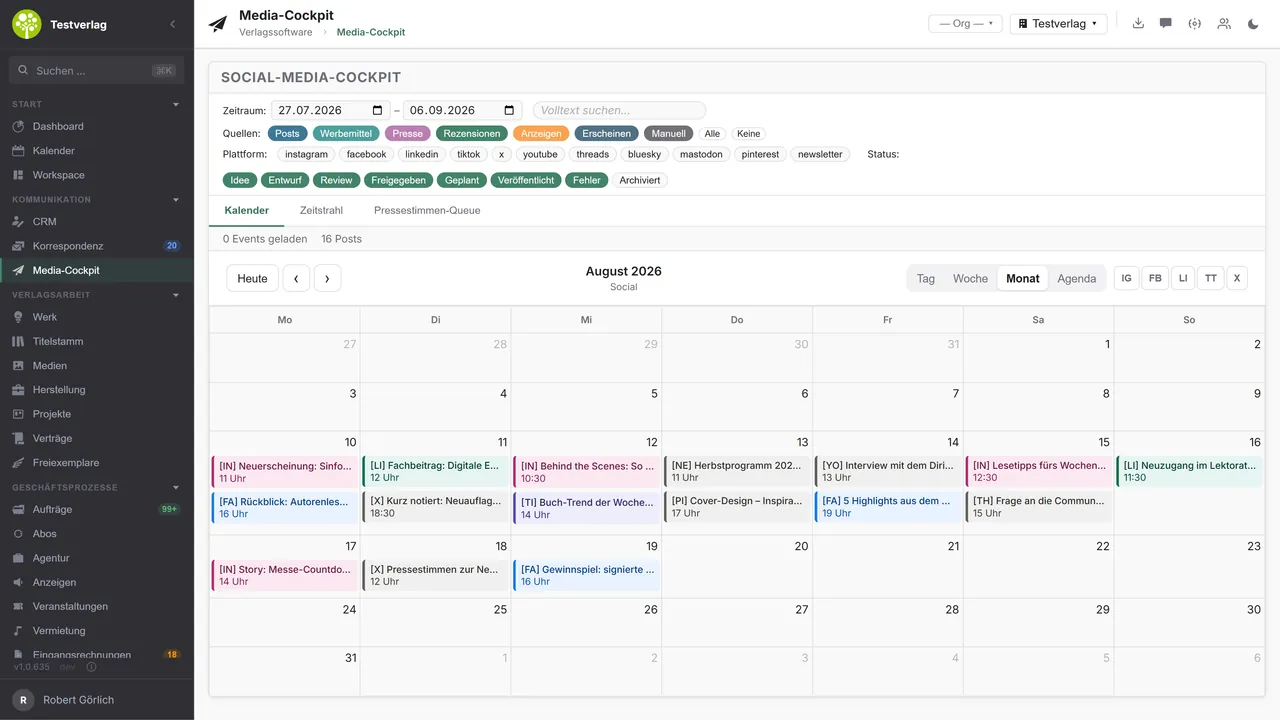
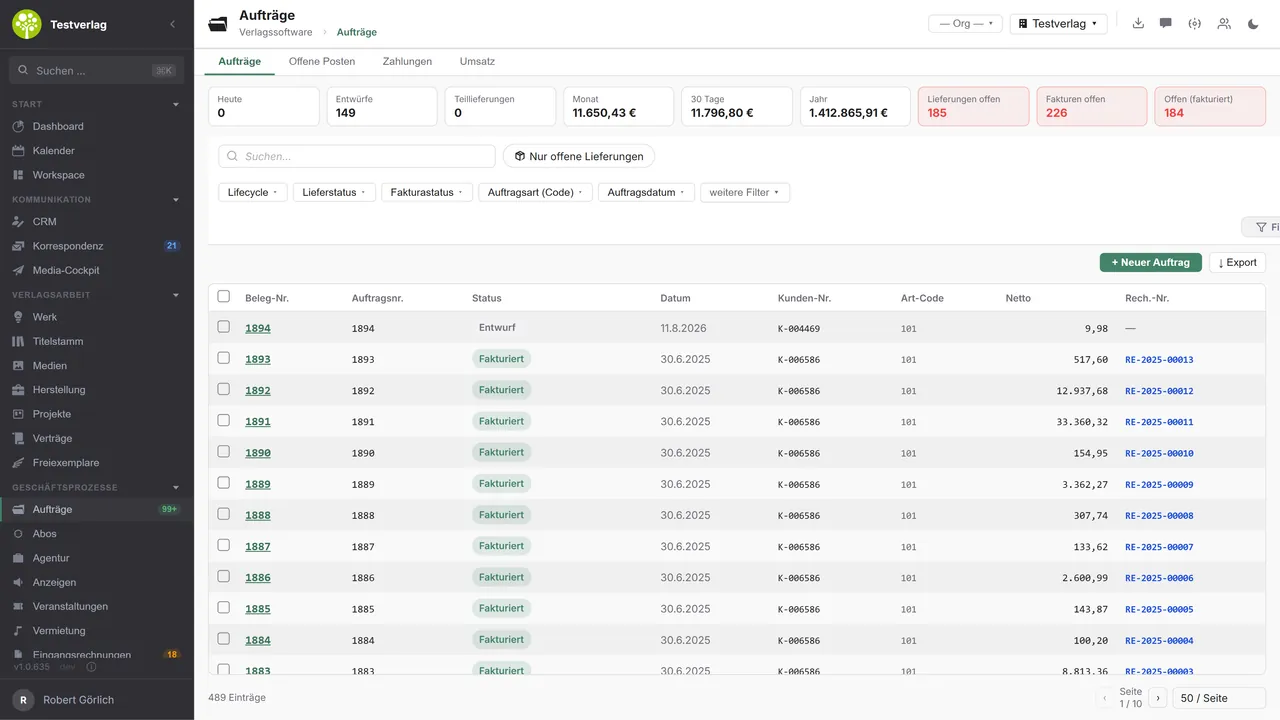
DashboardKey figures, top titles and recent orders at a glance.
Title dataONIX 3.0, VLB reporting & subject classification.
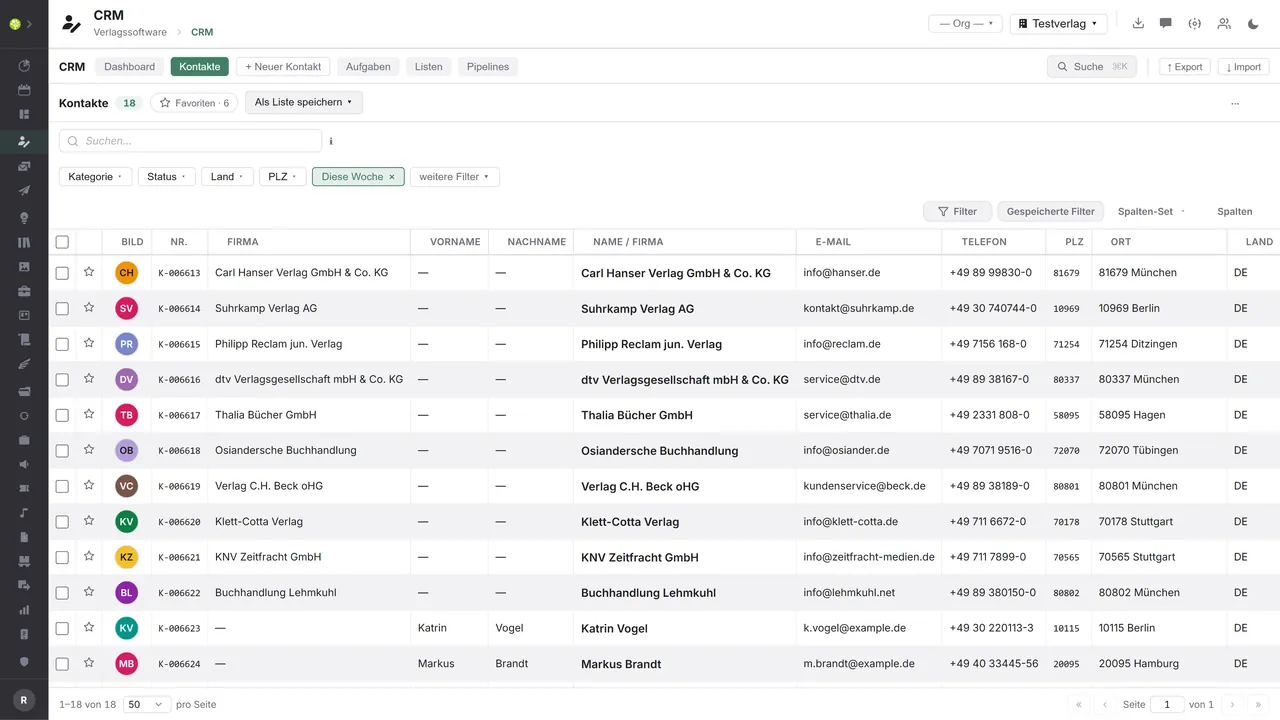
CRMAddresses & customers managed centrally.
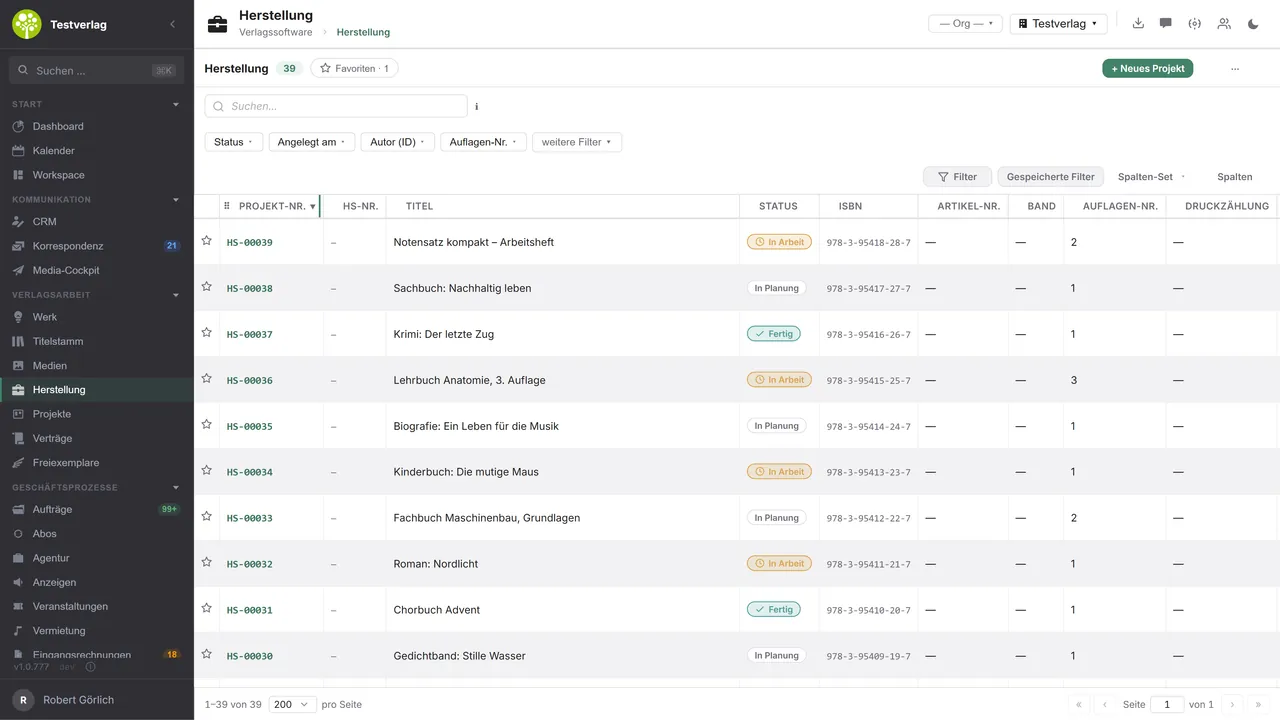
ProductionProjects, costing & scheduling.
Media CockpitSocial media & communications planning.
OrdersFrom quote to invoice.
Your entire publishing operation in one application.
open.junixx is the browser-based publishing software from juni.com – your entire publishing operation in a single application.
From title data and works through CRM, production, orders and advertising to the Media Cockpit and dashboard, every process meshes with the next – ONIX 3.0, multi-tenant and multilingual, with AI support exactly where publishing work loses time.
With the 2026 major release, open.junixx becomes fully browser-based and platform-independent – at the desk just as on tablet and phone, with nothing to install. Behind it sits an open technology stack of established open-source components (PostgreSQL, API-first with React, Node/Express and TypeScript): no proprietary licensing model in the foundations, plus one central, secure interface for import and export and automated quality control throughout.
One platform for your entire publishing operation.
From communication through the daily work of publishing to the business processes – every module meshes seamlessly with the next.

Communication
CRM
One central record of addresses and customers, linked into every publishing process.
View moduleCorrespondence
Email and letter templates with a complete history – straight from the contact.
View moduleCalendar
Appointments in one place – and as an iCal subscription in Outlook, Apple Calendar and Google Calendar.
View moduleGDPR
Data protection documentation in one central place – ready for inspection as a complete file.
View modulePublishing
Title data
ONIX 3.0 title management as your central product database.
View moduleWork
Maintain contributors, texts and music metadata once – for every edition beneath.
View module NewManuscript review
Pre-screen submitted manuscripts – with a recommendation, a fit assessment and editorial notes.
View moduleContracts & royalties
Contracts, rights and royalty settlement – through to reporting to the collecting society.
View moduleProduction
Costing, unit cost and carbon footprint – the whole production in one project.
View moduleMedia (DAM)
Digital asset management for covers, images and documents – centrally linked.
View module NewMedia Cockpit
Posts, press and advertising on one timeline – planned, approved, measured.
View moduleComplimentary copies
Handle complimentary, voucher and legal deposit copies cleanly.
View moduleBusiness processes
Orders & invoices
From quote to payment – for books, subscriptions, advertising, rentals and events.
View moduleAdvertising
Sell ad space – from booking to invoice.
View module NewIncoming invoices
Capture documents, assign accounts, approve – and export as a DATEV batch.
View module NewApp orders
A back-office inbox for orders from the sales rep app, with an approval workflow.
View moduleWarehouse
Stock levels, reorder points and goods receipt under control.
View moduleProcurement
Supplier orders in the third-party title business.
View module NewReporting
Revenue, budget and previous year side by side – without the detour through Excel.
View moduleSubscriptions
Subscriber management, invoicing included.
View moduleAgency
Service business with time tracking and invoicing.
View module NewEvents
Seminars, training courses and conferences – from registration to certificate.
View moduleRental
Hire out sheet music – from inquiry to settlement.
View moduleHow it all meshes together.
Every module draws on the data of the others – from the first contact to the final invoice.

AI that works alongside you.
open.junixx brings AI support directly into your workflows – for search, texts, metadata and correspondence. Which model does the work is your decision: your own provider, your own key – or, if you prefer, a model on your own premises that needs no connection to the outside world.
- Title search in natural language
- Drafts for blurbs and metadata
- A writing assistant in correspondence
- Provider and model freely chosen – your contract, your key
- On your own premises if you wish – your texts never leave your network

See open.junixx at work. We show you on screen how the software fits your publishing workflows – with no obligation, and with time for your questions.
Book a demoConnected to your systems through an open API.
Through one central, secure API, open.junixx connects to your services – from AI and metadata to shops, marketing and distribution. A hub where every thread comes together.


 open.junixx platform
Invoice recipients
One system, many publishers.
Several publishers, imprints or subsidiaries work in one installation – with separate data and their own settings per tenant. And within each tenant, a graded permission model decides who may see and change what. Right down to the individual user.

Tenants with their own rules
Number ranges, invoicing rules, document templates, shop and AI credentials, even which modules are enabled: all of it is set per tenant. A user can belong to several tenants and switches between them in the application header.
Permissions in six levels, per module
From “no access” through read, write, delete and export to admin – separately for every module. Permissions are granted through groups, and templates with ready-made permission sets are there for the initial setup.
Exceptions without a new group
An individual user can be given additional permissions without needing a group of their own. And a hard block per module overrides any group permission – where it is set, the door is shut, regardless of what the group allows.
Every change is on record
Who changed what and when is held in the change log across all modules, with the old and the new value; individual changes can be rolled back one by one. Changes to permissions are logged separately.
| Module | Publisher A | Publisher B |
|---|---|---|
| Title data | Admin | Read |
| Contracts | Write | no access |
| Production | Read | Read |
| Reporting | Export | blocked |
Six permission levels per module
- no access
- Read
- Write
- Delete
- Export
- Admin
A fit for your kind of publishing.
Every publisher works differently. open.junixx brings exactly those modules to the front that matter in your segment.

Book publishers
Backlist, production costs and list decisions – the core processes of the book business.
02
Professional publishers
Relief when editorial capacity is tight – and control over AI and costs.
03
Textbook publishers
Edition variants, inspection copies and budget planning for the education market.
04
Special interest
Reach, events and image rights – what special-interest publishing turns on.
05
Magazine publishers
Digital subscriptions, advertising and billing – even as the sales channels shift.
06
Music publishers
Hire out performance material, settle rights – in the logic of music publishing.
On-premises or cloud.
Where the application runs is decided by your house. The same software, the same modules, the same data – all that differs is who runs the server.
Cloud with no US servers No US services, no dependency.
In your hands
The server stands where you want it: with you or with a provider of your choice. Backup, network and access are yours to set.
Learn moreIn the cloud
The server stands in a data center, and we take on the operation. The work happens in the same browser.
Learn moreIn your hands
- You decide where it runs. We hand the application over to you, and you operate it – on a server in your own house or with a provider you trust. Who reaches it from outside is your administration’s call.
- Backup in your own cycle. The backup runs along with your existing concept, with your retention periods. No copy of your data lies with a third party.
- What the server needs. Delivery is as a container application with PostgreSQL – a Linux machine with Docker is enough. New versions you install when it suits your operation.
In the cloud – Your data. Your control. European law.
- We take on the operation. Setup, updates, backup and monitoring lie with us. Your house needs neither a server of its own nor its own administration.
- Servers in the European Union. Your installation runs on servers in the EU. For its operation we use no US servers and no US services; publishing data is not transferred to the USA. The basis is a data processing agreement under the GDPR.
- No way is barred. It is the same software as on your own premises. A change remains possible in both directions – with your data.
Not every team speaks the same language.
The language belongs to the user account, not to the installation. Your team in Amsterdam, Paris or Athens works in the same tenant, on the same data – each in their own language.
Every user in their own language
The language setting sits in the user account and applies from sign-in onwards. Each tenant has a default language for new accounts – and anyone who switches stays in the same application, with the same permissions and the same data.
Documents in the recipient's language
Form variants have language versions of their own. Which one is used the application works out for itself: the recipient's language preference, failing that their country, failing that the tenant's default language. Amounts and dates follow suit.
Correspondence with language templates
Letter and email templates exist per context, document type and language, with exactly one default template for each combination. Change the language in the form and the draft changes with it, immediately.

Available in
- Deutsch
- English
- Nederlands
- Français
- Italiano
- Español
- Ελληνικά
About us

Behind open.junixx stands juni.com: founded in 1990 as an advertising agency, specializing in digital solutions since 2001. With open.junixx.FM we have been building software specifically for publishers since 2005 – and we know how they work from collaborating with them every day. That experience is what now sits inside the browser-based open.junixx platform.
Publishers who work with juni.com




























Connected to the publishing ecosystem
- VLB
- IDNV
- doctronic
- Amazon
- Bookwire
- Arvato / VVA
- Brocom
- Prolit
- Zeitfracht
- Magento
- WordPress /
WooCommerce - Shopify
- Shopware
- Wirth & Horn
- Diamant
- DATEV
- BMD
- Abacus
- DHL
- DPD
Get to know open.junixx.
Arrange an appointment with no obligation. We will show you how open.junixx fits the way your publishing house works.
juni.com GmbH
Münchener Straße 41 · 60329 Frankfurt am Main
+49 69 5077 5780 · info@juni.com
News from juni.com.
Our four most recent posts – shown here on our own site, with no embedding and without any data going to Meta.