

From the inquiry to the GEMA report.
Quotations & rental cases
The price comes from the rate engine – region, category, performance duration, special use – as a preview, before anything is saved. From costing through quotation to case, with no re-entry.
Every performance recorded individually
Concert, opera, ballet, broadcast, recording, streaming – with date, venue, size of ensemble and participants. Once published, the use appears in the calendar and stays in sync with it.
Invoices & return reminders
A daily check finds overdue shipments, counts the days and proposes the reminder level. Invoices are created from allocations – individually or as a combined order.
Reports to collecting societies
The GEMA file is built from the performances already recorded – with a preview, a duplicate check against what has been reported before, and a history of runs available for download again.
Hiring out sheet music is a logistics business.
Hiring out sheet music is a logistics business.
An orchestra needs the score and the parts on a date, at a place, for a particular performance – and afterwards the material has to come back, complete and on time. Add prices by region and performance duration, reports to the collecting society, commissions for agents. This is the largest area of the application, and it has a clear core.
That core is the rental case: one customer hiring particular material for a particular period. Around it sit the stages that come before (inquiry costing and quotation), the management of the material, shipping, the performances and the commercial handling. The case itself has tabs of its own for master data, line items, deliveries, uses, invoices, correspondence, links and documents.
The material is held as a bundle with sets. A bundle is the material available for hire; a set is one physical copy of it, with a number, a condition, a storage location and a parts list of part types with target and actual counts. If a part is permanently missing, that is recorded there, with the reason. The current availability per item takes into account what is out of the house, what has just come back and which outbound shipments are still open. Sets can be blocked, reserved and booked into the warehouse, and each one has a history of every case it appeared in.
The instrumentation behind it is structured, not free text, with part types per work or title and the markers obbligato, ad libitum and divisi, insertable from your own templates, from work sets or from the mirrored instrument catalog. Works, sheet music metadata and song rights come from title data and work; the hirers, agents and venues come from the CRM.
Prices are calculated by a rate engine: regions each in their own currency, categories within them, and duration-based scales within those, plus surcharges and discounts for special uses as well as separate rates for sync licenses by duration and for archive copies by page count. The preview shows the price before anything is saved; a price entered by hand requires a reason. And VAT is a result, not an entry: it follows from the type of line item, the country of delivery and the type of hirer – end customer, domestic B2B, B2B within the EU with a VAT identification number, or non-EU.
Shipping runs in steps: release, book out, book in. On booking out, the set switches to on loan and is taken out of the warehouse; on booking in, back again. The delivery note can bundle several consignments of one shipment and carries the actual delivery address (concert hall, orchestra office, library) together with performance dates, work details per line and the consignment number. For material with no title assigned there is the blank delivery note. On return, the inspection grades the material as complete, incomplete, damaged or lost, and sets the status of the set from that.
What holds it all together is the bundle cockpit: an availability view per set of material, as a calendar or a timeline, showing sets, cases, costings, deliveries, performances and blocks in one picture. It detects conflicts where cases overlap, but leaves them out when demonstrably different sets are involved. Because two concerts on the same evening are no problem, as long as there are two sets of parts.
At the end comes the billing. Invoice allocations carry a type, a due-date rule and an amount, and become real orders in Orders & invoices, individually or as a combined order, with a check for mixed currencies. Agent commissions run along as internal line items on the case and are carried through cancellation and reactivation. And the performances, recorded anyway, become the GEMA report – with preview, export including a log, a status change to reported, and a duplicate check, with works out of copyright left aside.
Rental in the application.

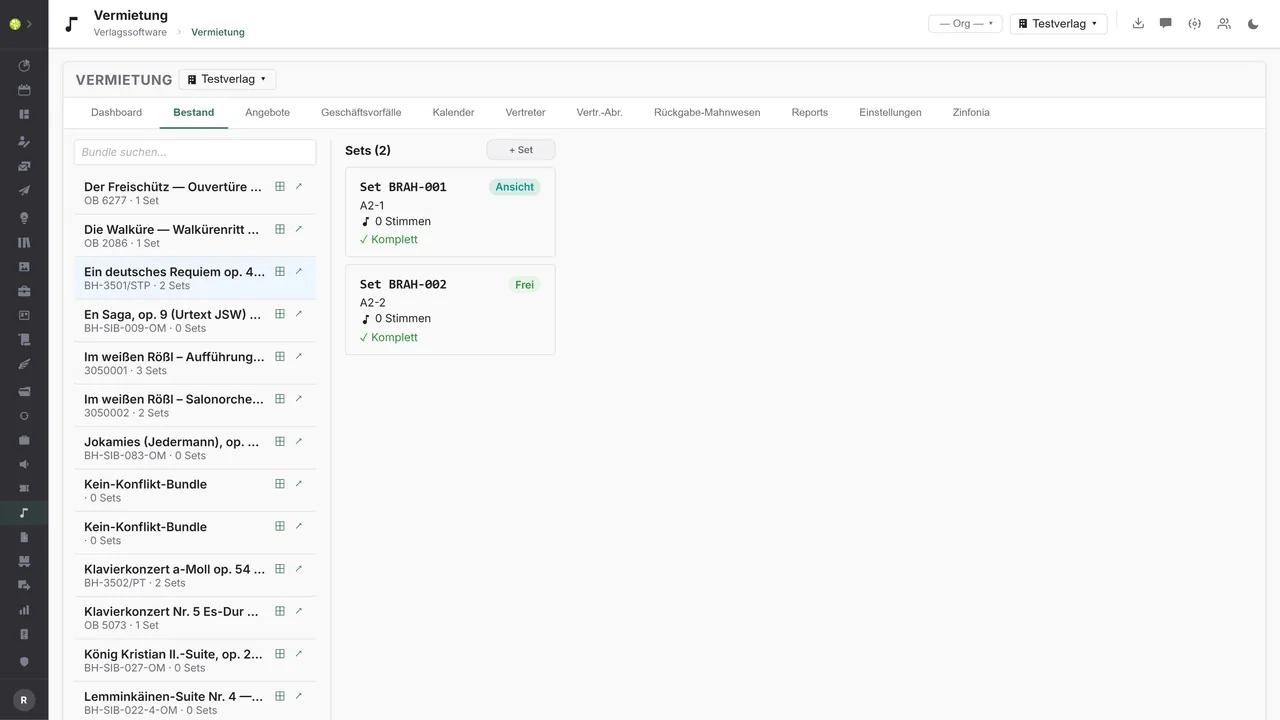

Material and its setsOn the left the bundles with item number and number of sets, on the right the physical sets: number, storage location, number of parts, completeness and availability – free, on approval, blocked.
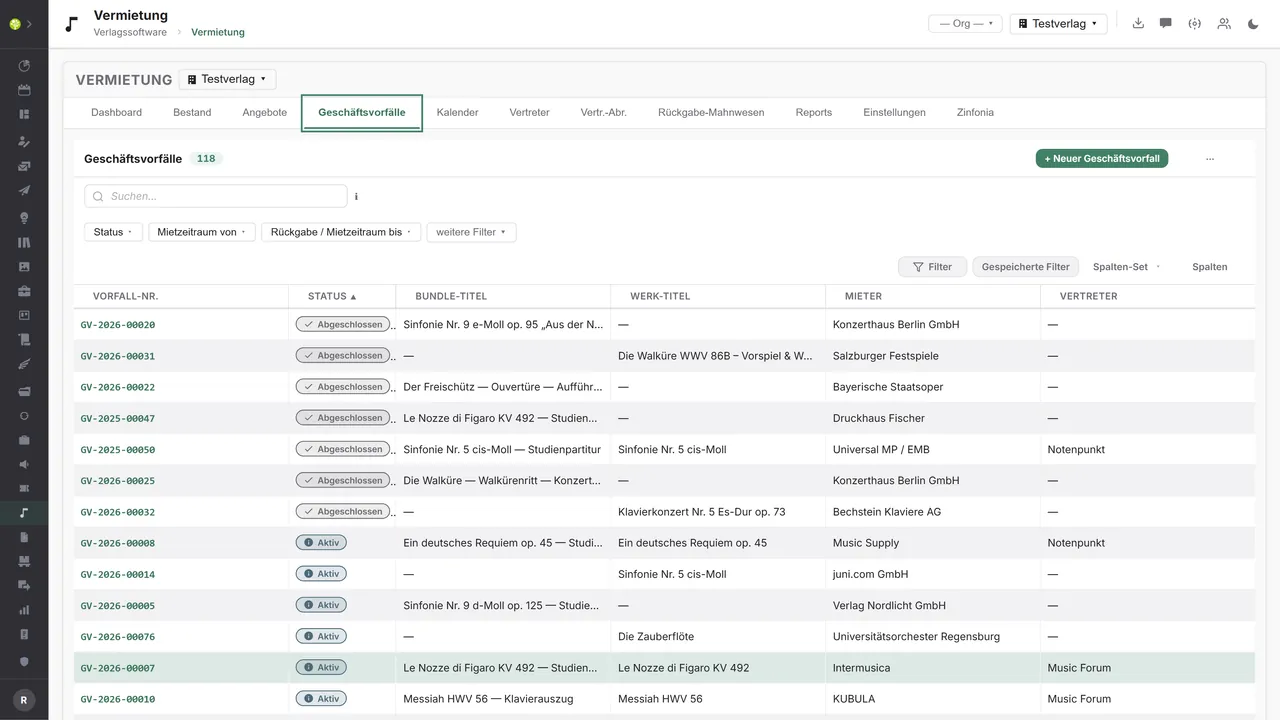
Every rental caseCase number, status, bundle, work, hirer and agent – with filters for status, hire period and return, saved filters and selectable column sets.
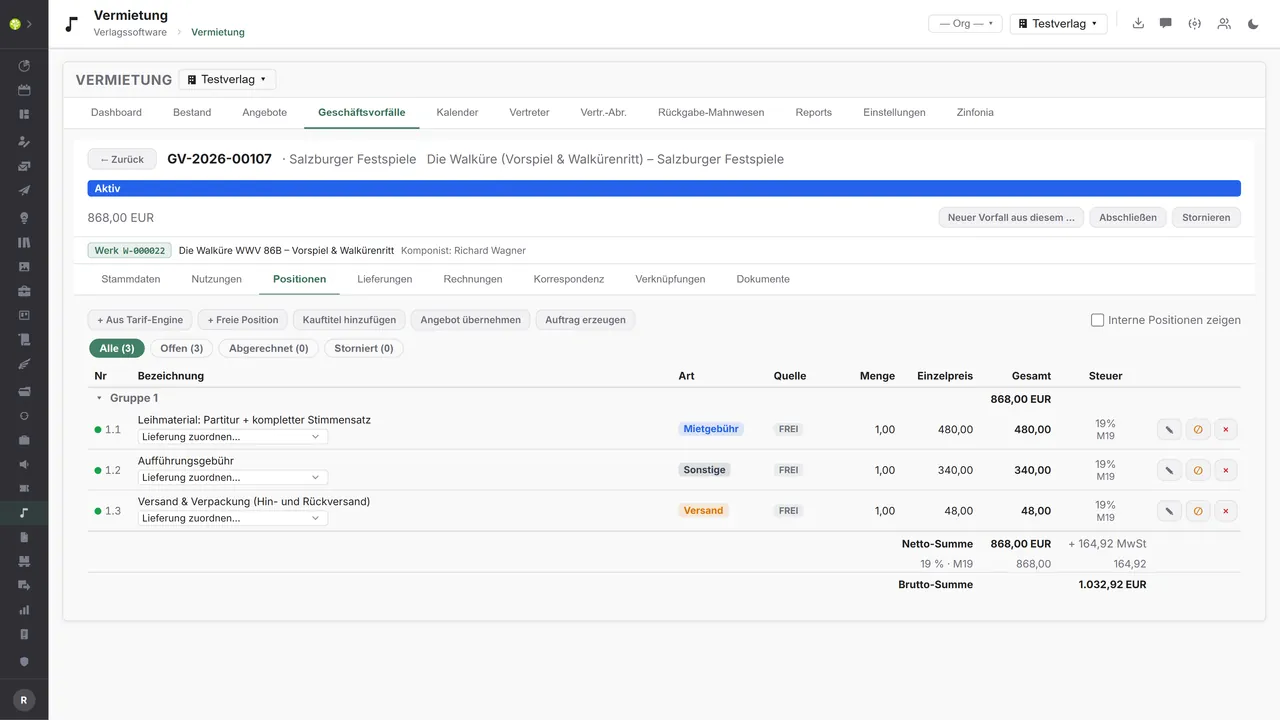
Line items with tax and totalsHire fee, performance fee and shipping as line item types of their own, each with quantity, unit price, total and tax rate – and below them net, the tax line and gross. Line items can be assigned to a delivery.
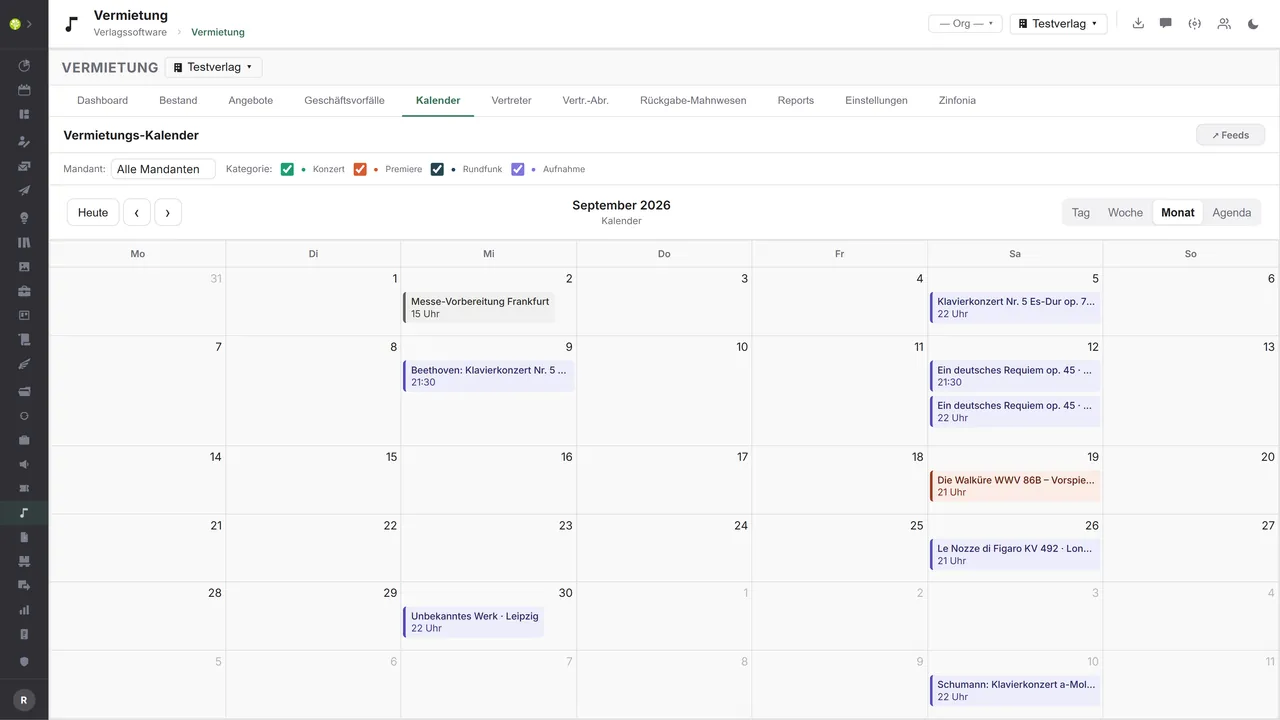
Performances in the calendarConcerts, premieres, broadcasts and recordings separated by color and switchable one by one, as day, week, month or agenda – across all tenants and available as a feed.

See open.junixx at work. We show you on screen how the software fits your publishing workflows – with no obligation, and with time for your questions.
Book a demoImport and export through the API.
No other module is as well wired to the outside: the collecting society, the international hire network and the broadcasters' order form are all connected. What remains open is the shipping route.

Import – from external services
Data flowing into the module from outside:
- Response from the collecting society with confirmed work numbers → the reporting status is correct with no follow-up entry
- Inquiries, orders and messages from the Zinfonia hire network → costing and case are created by themselves
- The broadcasters' standard order form as an Excel file → inquiry, order and use without typing anything out
- Consignment status and return shipment from the carrier → the reminder system knows when something is genuinely on its way

Export – to external services
Data the module passes outward:
- Performance reports with ISWC, work number and special use to GEMA, GVL and VG Musikedition → from the uses already recorded
- Work and catalog data as well as offers to Zinfonia → visible in the international market
- Recipient address, parcel and return deadline to the carrier → shipping label and tracking
- Performance dates to the website, the press or concert databases → the schedule maintains itself
A great deal is already connected: the GEMA report goes out as a file and the response comes back; for collecting societies there is also work registration as CWR and IWA-XML. Zinfonia is a genuine two-way connector – fetch orders, place and transfer the catalog, accept inquiries through a webhook, report status back. The broadcasters' order form is read in as an Excel file, with the stage detected automatically, and the delivery note is produced through the form engine. For shipping, carrier, consignment number and shipping costs are fields in the process, but there is no connection to a carrier interface – labels, tracking and customs papers for international consignments would be the next step, as would an outbound calendar feed.
More on the interfaces
Detailed overview from the interface analysis: sources for import and possible targets for export.
Import – from external services

| Source (external) | What is imported | Use in the module |
|---|---|---|
| GEMA response (in place) | Confirmed work numbers and status | Reporting status and registration are correct with no follow-up entry |
| Zinfonia (in place) | Incoming inquiries, orders, messages | Costing and case are created automatically |
| Broadcasters (in place) | Order form and usage data | Quotation, case and GEMA report without typing anything out |
| UIC instrument catalog (in place) | Instruments, descriptors, groups | Part types named consistently and resolvable |
| Carrier | Consignment status, delivery, return shipment | Manage returns and reminders more precisely |
Export – to external services

| Purpose / trigger | External service (examples) | What is exported | Format / standard |
|---|---|---|---|
| Performance report (in place) | GEMA, GVL, VG Musikedition | ISWC, work number, performance, special use | CSV, CWR, IWA-XML |
| Catalog and inquiries (in place) | Zinfonia | Work and catalog data, offers | Zinfonia API |
| Delivery note (in place) | Customer, freight forwarder | Consignment with sets, parts and dates | |
| Shipping the material | DHL, DPD, GLS, freight forwarder | Recipient address, parcel, return deadline | Carrier API, GS1 |
| International shipping and customs | Customs, courier | Proforma invoice, customs value | Customs and carrier API |
| Performance calendar | Website, press, concert databases | Performance dates and premieres | iCal, JSON |
Every feature of Rental.
You will find the complete list in our brochure
What you see above is an excerpt. Every feature of this module – and of all the others – is collected in the open.junixx brochure. We will gladly send it to you, in print or as a PDF. And if you would rather watch than read: we are happy to show you open.junixx live on screen.
Get the brochureBuilt for music publishers.
Hiring out orchestral, choral and stage material is a business of its own – with its own logistics, its own rates and its own reporting duties. This module is built for it.

Connected to the publishing ecosystem
- VLB
- IDNV
- doctronic
- Amazon
- Bookwire
- Arvato / VVA
- Brocom
- Prolit
- Zeitfracht
- Magento
- WordPress /
WooCommerce - Shopify
- Shopware
- Wirth & Horn
- Diamant
- DATEV
- BMD
- Abacus
- DHL
- DPD
Get to know open.junixx.
Arrange an appointment with no obligation. We will show you how Rental fits into your publishing routine.